How to Balance Quality, Lead Time, and Cost Effective Uniform Manufacturing Vietnam?
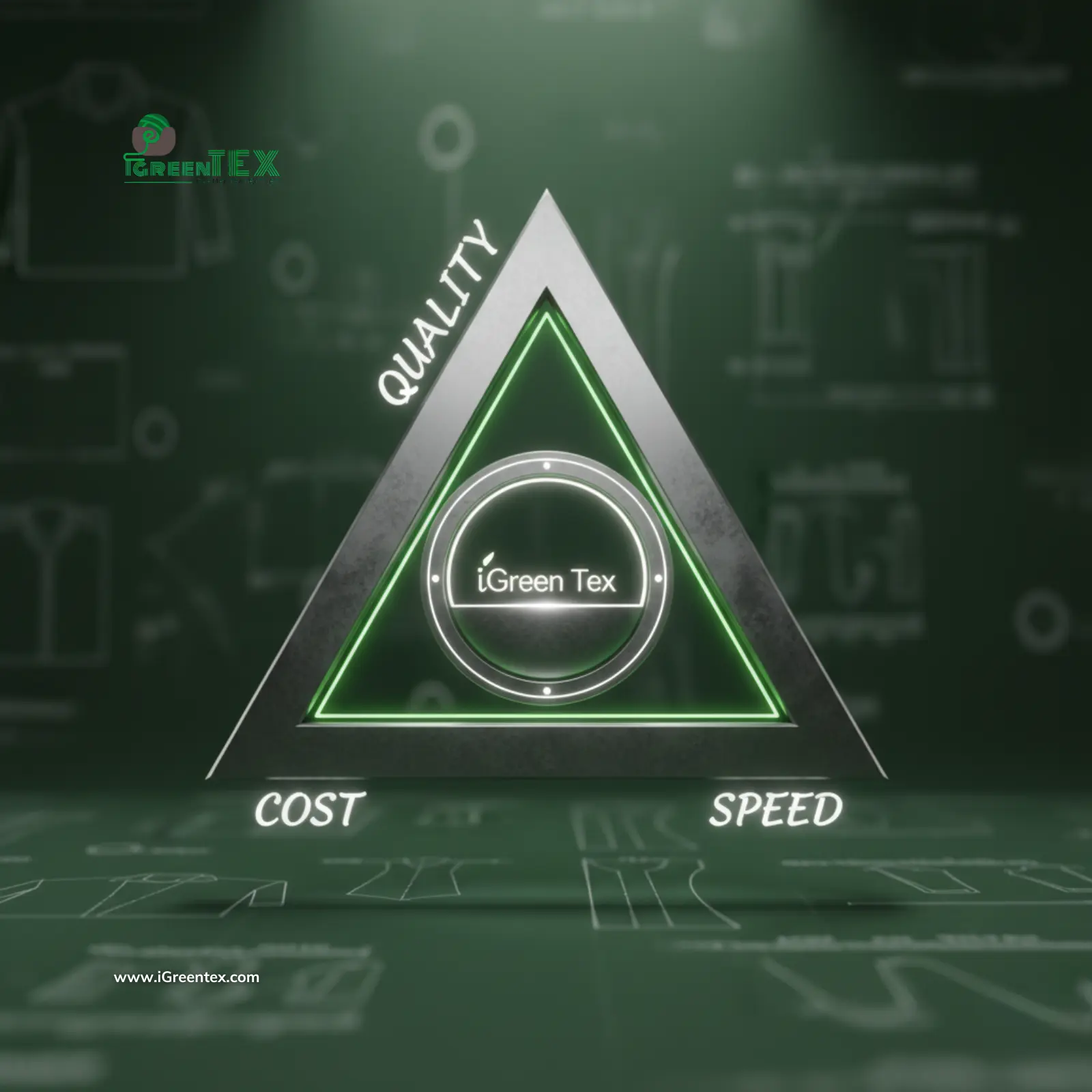
THE “IRON TRIANGLE” OF MANUFACTURING
In project management and industrial engineering, there is a famous concept called the “Iron Triangle.” The three corners are Quality, Speed (Lead Time), and Cost. The old rule of thumb in the garment industry says: “You can only pick two. If you want it good and fast, it won’t be cheap. If you want it good and cheap, it won’t be fast.”
For Sourcing Managers and Corporate Buyers, this triangle is the daily battlefield. You are under constant pressure to reduce the procurement budget, ensure the uniforms last for years, and have them ready for the company launch next month.
Many suppliers promise all three but fail to deliver. As a result, buyers often find themselves searching for cost effective uniform manufacturing Vietnam solutions but ending up with either low-quality goods or delayed shipments.
At iGreen Tex, we believe the “Iron Triangle” isn’t about sacrificing one factor; it’s about optimization. The goal of cost effective uniform manufacturing Vietnam is not simply finding the lowest price tag. It is about engineering a process where waste is eliminated, quality is built-in, and speed is optimized through planning.
This article is a technical deep dive. We will strip away the marketing fluff and look at the actual mechanics of production. We will explore how to achieve true cost effective uniform manufacturing Vietnam results by mastering AQL standards, critical path management, and strategic material sourcing.
PART 1: DECODING “HIGH QUALITY” IN COST EFFECTIVE MANUFACTURING
There is a misconception that “cost effective” means “low quality.” This is false. In fact, low quality is expensive. High defect rates lead to returns, reproduction costs, and brand damage. Therefore, a true cost effective uniform manufacturing Vietnam strategy must prioritize quality control to prevent financial loss.
When we talk about quality in a professional context, we use the AQL standard in garment industry (Acceptable Quality Limit). This is the statistical language of mass production.
The Connection Between AQL and Cost Efficiency
To achieve cost effective uniform manufacturing Vietnam outcomes, you must define your AQL standard correctly:
- AQL 2.5 (Standard): Used for most corporate uniforms. It balances quality with inspection time.
- AQL 4.0 (Budget): Allows more minor defects. It is cheaper but risky for premium brands.
- AQL 1.5 (Premium): Very strict. It increases cost because inspection takes longer and rejection rates are higher.
Smart buyers choose AQL 2.5 as the “sweet spot” for cost effective uniform manufacturing Vietnam. It ensures the uniforms look professional without incurring the excessive costs of luxury-grade inspection.
The 4-Stage QC Protocol
To ensure that our cost effective uniform manufacturing Vietnam process delivers consistent results, iGreen Tex implements a rigorous 4-stage defense. We do not wait until the end to check quality; that would be too expensive to fix.
Table 1: The QC Critical Path for Cost Efficiency
| Stage | Action | Technical Standard | Cost Impact |
| 1. Incoming Material | Fabric Inspection | 4-Point System (ASTM D5430) | Prevents cutting bad fabric (Saves |
| 2. Pre-Production | PP Sample Review | Size Set Match | Prevents bulk sizing errors (Saves |
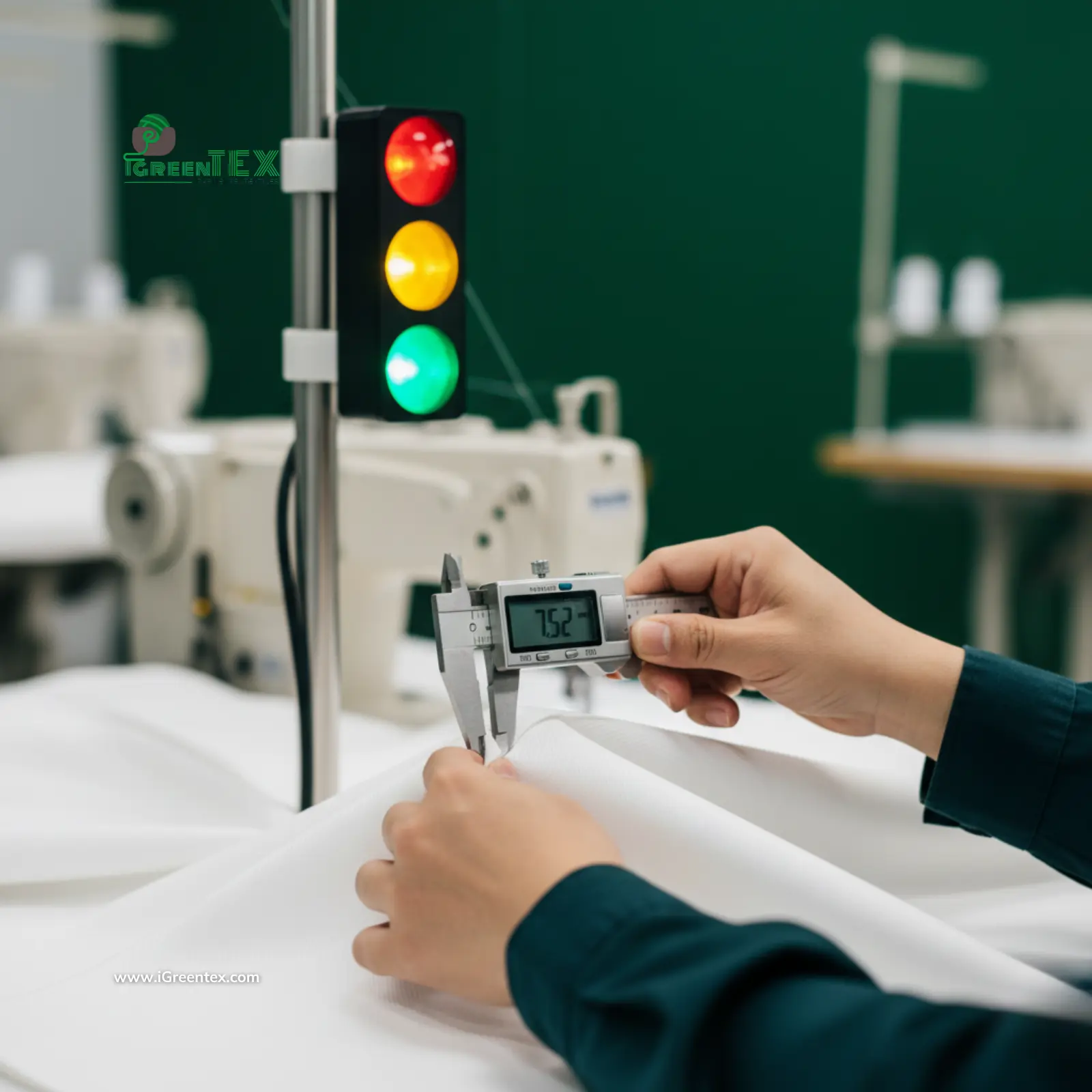
| 3. Inline (Traffic Light) | Roaming QC | Random Line Checks | Fixes sewing errors instantly (Saves Time) |
| 4. Final Audit | Pre-shipment Check | AQL 2.5 Standard | Ensures zero returns (Saves Brand Reputation) |
By catching defects early, we minimize waste. This reduction in waste is the secret engine behind cost effective uniform manufacturing Vietnam.
PART 2: DECODING “LEAD TIME” (THE HIDDEN COST)
Time is money. A delayed shipment can mean air freighting goods at 5x the cost of sea freight. Therefore, managing lead time is a critical component of cost effective uniform manufacturing Vietnam. We strongly recommend you analyze the workflow detailed in our pillar guide on [Top 3 Must-Knows When Uniform Manufacturing in Vietnam]
To understand Vietnam clothing factory lead time, you must look at the “Critical Path.”
The Breakdown of 45 Days
Let’s analyze a standard order of 5,000 Polo Shirts using imported fabric.
Table 2: Standard Production Timeline (The Critical Path)
| Phase | Duration | Activity | Impact on Cost Effective Manufacturing |
| Phase 1: Lab Dips | 5-7 Days | Matching Pantone colors | Delays here cause rush fees later. |
| Phase 2: Material Sourcing | 15-20 Days | Weaving & Dyeing Fabric | The biggest bottleneck. |
| Phase 3: Cutting & Sewing | 10-12 Days | Production Line | Automated cutting saves time/money. |
| Phase 4: Embellishment | 3-5 Days | Printing / Embroidery | Integrated services reduce transport cost. |
| Phase 5: Finishing & QC | 3-5 Days | Ironing, Packing, AQL | Final validation. |
| Total Lead Time | 35-45 Days |
How to Shorten Lead Time for Cost Savings?
If you need to accelerate the process while maintaining a cost effective uniform manufacturing Vietnam budget, you have two technical options:
- Use Available Stock Fabric: By skipping Phase 2 (Weaving & Dyeing), you save 15-20 days. You also avoid dyeing surcharges. This is the number one strategy for cost effective uniform manufacturing Vietnam for small to medium orders.
- Approve Digital Samples: Instead of shipping physical samples back and forth (costing
50−50−100 per courier and 4 days), use 3D rendering or high-res video approval. This significantly lowers the pre-production cost.

PART 3: “CHEAP” VS. “COST EFFECTIVE” – KNOW THE DIFFERENCE
There is a dangerous difference between a “cheap” factory and a partner who offers cost effective uniform manufacturing Vietnam.
- “Cheap” usually means cutting corners: using low-GSM fabric that shrinks after one wash, skipping the Inline QC, or using illegal underpaid labor. This results in high hidden costs (returns, brand damage, shorter product lifespan).
- “Cost Effective” means Value Engineering. It is about optimizing the design and process to reduce cost without sacrificing performance.
Understanding the breakdown of [uniform manufacturing costs] is key. Here is how iGreen Tex engineers lower prices to provide true cost effective uniform manufacturing Vietnam solutions.
1. Pattern Efficiency (Marker Making)
Fabric accounts for 50-60% of the total garment cost. If you want cost effective uniform manufacturing Vietnam, you must focus on fabric consumption.
- Inefficient Factory: Uses a manual layout. Fabric utilization = 75%. Waste = 25%.
- iGreen Tex: Uses CAD software (Gerber/Lectra) to nest patterns. Fabric utilization = 85%+.
- Result: We buy less fabric for the same number of shirts. This makes us a highly cost effective uniform manufacturing Vietnam partner.
2. Strategic Fabric Selection
Instead of requesting “100% Cotton” (which is expensive and wrinkles easily), we suggest CVC (60% Cotton / 40% Poly) or TC (35% Cotton / 65% Poly).
- Benefit: These blends are cheaper, more durable for uniforms, and have better color fastness. This is “Value Engineering”—a core principle of cost effective uniform manufacturing Vietnam.
3. Economy of Scale
As we discussed in our article about [small batch manufacturing challenges], low quantities drive up the unit price due to fixed setup costs. To maximize the benefits of cost effective uniform manufacturing Vietnam, we advise clients to consolidate orders. Instead of ordering 500 shirts every month, ordering 1,500 shirts quarterly can reduce the FOB price by 10-15%.

PART 4: WHY VIETNAM IS THE DESTINATION FOR COST EFFECTIVENESS
Why is the keyword cost effective uniform manufacturing Vietnam trending globally? Why not Bangladesh or China?
1. Labor Cost vs. Skill Ratio
When evaluating the global manufacturing landscape in 2026, Vietnam occupies a unique strategic position that balances capability with affordability, often referred to as the “manufacturing sweet spot.” While China has historically been the industry leader, its economic maturity has pushed average manufacturing wages to approximately $6.50 per hour. This rise makes it increasingly difficult for brands to maintain healthy margins on mid-range uniform products. On the opposite end of the spectrum, nations like Bangladesh offer significantly lower labor costs; however, they often lack the technical infrastructure and workforce flexibility required for complex, high-detail garments, carrying a higher risk of quality variance.
Vietnam sits perfectly in the middle ground, with an average labor cost of roughly $3.00 per hour. Yet, the math goes beyond just the hourly wage. The Vietnamese workforce is globally renowned for high manual dexterity, discipline, and adaptability—capable of executing complex sewing techniques that cheaper markets cannot execute reliably. This precise balance—offering “China-level quality” at a significantly lower price point—is the fundamental foundation of cost effective uniform manufacturing Vietnam. It allows corporate buyers to secure high-quality, durable uniforms without the premium price tag of East Asian competitors or the quality risks of South Asian alternatives.
2. Vertical Integration
Vietnam is investing heavily in its own fabric mills. The ability to source fabric locally reduces logistics costs and import duties from China. This local supply chain enhances the viability of cost effective uniform manufacturing Vietnam.
3. Free Trade Agreements (EVFTA, CPTPP)
For buyers in Europe or Australia, cost effective uniform manufacturing Vietnam becomes even more attractive when you factor in 0% import duties. A “cheap” shirt from a non-agreement country might end up costing more after tax than a quality shirt from Vietnam.
PART 5: THE OPTIMIZATION MATRIX (HOW TO CHOOSE)
You cannot have everything at maximum level. You must optimize based on your priority. Below is our “Trade-off Matrix” to help you define what cost effective uniform manufacturing Vietnam means for your specific project.
Table 3: The Trade-off Matrix
| Priority | What You Get | What You Compromise | Recommended Strategy for Cost Effectiveness |
| Priority: SPEED | 20-25 Day Delivery | Variety (Must use stock fabric) | Choose Stock Fabric + Air Freight. |
| Priority: COST | Lowest FOB Price | Lead Time (Sea freight required) | Plan 3 months ahead + Order > 2,000 pcs. |
| Priority: QUALITY | Complex Designs | Speed (More QC steps) | Allow extra 10 days for extensive testing. |
This matrix proves that cost effective uniform manufacturing Vietnam is not a fixed number; it is a variable that depends on your planning and priorities. As we discussed in our article about finding small batch clothing manufacturers in Vietnam, low quantities drive up the unit price due to fixed setup costs.
CASE STUDY: REAL WORLD OPTIMIZATION
To demonstrate cost effective uniform manufacturing Vietnam in action, let’s look at a recent project.
The Client: A logistics company in Australia needed 5,000 uniforms.
The Challenge:
- Target Price: $6.00 (Tight budget).
- Required Lead Time: 35 Days.
- Quality: Must withstand daily warehouse work.
The Initial Request: They asked for 100% Cotton Pique fabric dyed to a custom Pantone orange.
- Problem: 100% Cotton is expensive ($7.50 FOB) and custom dyeing takes 20 days. This request made cost effective uniform manufacturing Vietnam impossible to achieve under their constraints.
The iGreen Tex Solution (Value Engineering):
- Fabric Switch: We proposed a 65/35 Poly-Cotton Pique. It is stronger (better for warehouse work) and cheaper.
- Stock Color Match: We found a stock fabric in the local market that was a 95% match to their brand orange.
The Result:
- Cost: Reduced to $5.80 (Below budget).
- Lead Time: Reduced to 28 Days (Because we used stock fabric).
- Quality: Higher durability than the requested cotton.
This case study illustrates that cost effective uniform manufacturing Vietnam is achieved through consultation and technical expertise, not just bargaining.
CONCLUSION
Finding a partner for cost effective uniform manufacturing Vietnam is not about finding the factory with the lowest initial bid on Alibaba. The cheapest bid often comes with delayed production times, hidden fees, or a failure to meet basic quality standards.
True cost-effectiveness comes from balance. It comes from:
- Understanding the critical path to plan your timeline effectively.
- Using technical QC standards (AQL) to define quality clearly from the start.
- Value engineering your materials to save money where it counts.
At iGreen Tex, we don’t just take orders; we optimize them. We work with you to balance the Iron Triangle, ensuring your project achieves the goal of cost effective uniform manufacturing Vietnam.
Stop guessing with your budget and timeline.
If you are serious about cost effective uniform manufacturing Vietnam, you need a partner who understands the engineering behind the price.
Contact us today for a [Free Critical Path Analysis]. We will review your project and show you exactly how to optimize quality, speed, and cost before you spend a dollar.