Small Batch Clothing Manufacturing: Why Vietnam is the Smartest Choice for Growing Brands?
Quick Definition: What is Small Batch Clothing Manufacturing?
What is Industrial Small Batch Manufacturing?
Industrial Small batch clothing manufacturing refers to the production of apparel in limited quantities—typically between 300 to 1,000 units per style—using professional factory assembly lines rather than home-sewing methods. This model allows fashion startups and growing brands to test the market and manage inventory risks while maintaining high-quality standards, precise fabric sourcing, and competitive unit pricing compared to mass production.
Introduction: The Sourcing Dilemma for Growing Brands
Launching a fashion brand is an exciting journey. However, finding the right production partner is often the biggest hurdle. Most new founders face a harsh reality. Local tailors in the USA or Europe are too expensive. Conversely, massive factories in China or Bangladesh often ignore inquiries under 10,000 units. You need a middle ground. You need professional Small batch clothing manufacturers who understand quality but offer flexibility.
This is where Vietnam enters the equation.
Vietnam has evolved beyond just a hub for fast fashion giants. Today, it is the premier destination for mid-sized brands that demand high quality. At iGreen Tex Vietnam, we bridge the gap between “handmade” and “mass production.” We provide a professional industrial environment for brands ready to scale.
In this guide, we will analyze why shifting your production to Vietnam is a strategic move. We will also clarify the true definition of “Small Batch” in a professional context. You will learn how to optimize your costs and why our Minimum Order Quantities (MOQs) are designed to protect your profit margins.
1. Redefining “Small Batch” for Professional Success
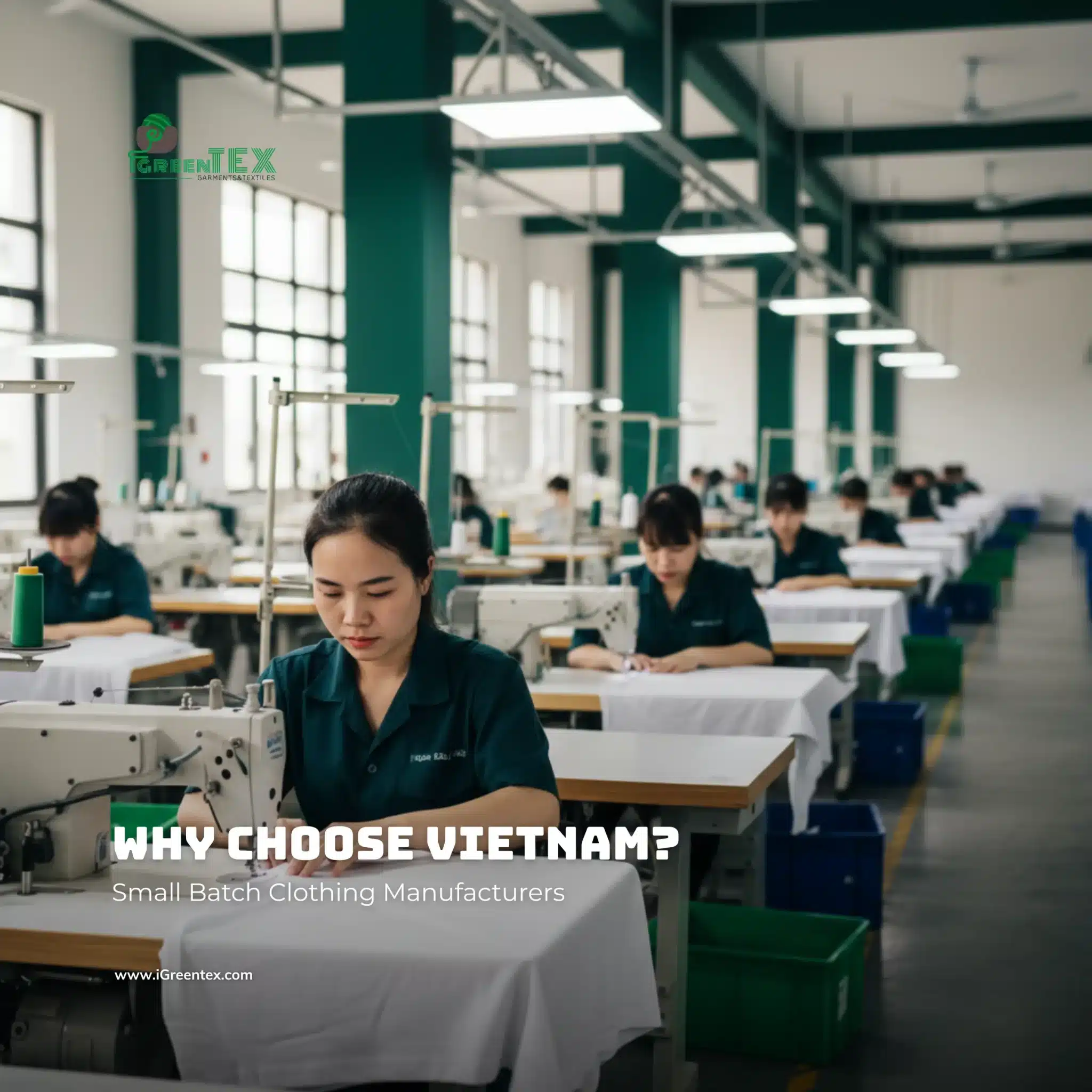
There is a common misconception about the term “Small Batch.” Many startups believe this means ordering 20 or 50 t-shirts. In the world of professional manufacturing, that volume belongs to “Sample Rooms” or “Tailor Shops,” not industrial factories.
To achieve retail-quality durability and competitive pricing, production lines must run efficiently.
The iGreen Tex Standard: Why Volume Matters
At iGreen Tex, we define Small batch manufacturing based on efficiency and fabric utilization. Our goal is to offer you the best FOB (Free on Board) price. If the quantity is too low, the cost per unit skyrockets. This eats into your profit.
To support our clients effectively, we have established clear MOQ structures. These numbers ensure you get industrial-grade quality at a price that allows you to scale.
Our Standard MOQs (Minimum Order Quantities):
| Market Target | MOQ Range (Per Style/Color) | Why This Range? |
| Domestic (Vietnam) | 300 – 500 Pieces | optimized for local logistics and smaller market testing. |
| Export (USA/EU/Aus) | 500 – 1,000 Pieces | Necessary to offset shipping, customs, and documentation costs. ensures the landed cost per unit remains profitable for you. |
Why “Too Small” is Dangerous for Your Business
Finding Small batch clothing manufacturers willing to produce 50 items is risky. Here is why:
- Inconsistent Quality: Very small orders are often sewn by single operators, not assembly lines. This leads to sizing variations.
- Fabric Limitations: You cannot dye custom fabric colors for 50 shirts. You are forced to buy expensive retail fabric.
- High Unit Cost: The setup cost for screens, patterns, and machines remains the same. Spreading $500 of setup costs over 50 shirts adds $10 to every shirt. Spreading it over 500 shirts adds only $1.
By targeting 500 to 1,000 pieces, you unlock the full power of Small batch clothing manufacturers like iGreen Tex.

2. The Economics: Vietnam vs. USA and Europe
Many Western startups initially look for Small batch clothing manufacturers in their home countries. They search for “Cut and Sew near me.” While local communication is easy, the economics often fail.
Let us look at the numbers.
The Cost of Labor
In the USA, a skilled sewing operator earns between $15 to $25 per hour. In Vietnam, labor costs are significantly lower, yet the skill level is world-class. Vietnam has a long history of textile expertise. This difference allows us to allocate more budget to high-quality fabrics rather than just labor.
The Supply Chain Advantage
Vietnam is a powerhouse for raw materials. We are close to major fabric mills and accessory suppliers. If you manufacture in the UK or USA, you likely still import fabrics from Asia. This adds shipping time and cost before production even begins. When you work with Small batch clothing manufacturers in Vietnam, the supply chain is localized.
Comparison Table: Producing a High-End Cotton Polo Shirt
| Feature | Local Manufacturer (USA/EU) | iGreen Tex (Vietnam) |
| Labor Cost | High ( | Competitive ( |
| Fabric Sourcing | Limited (Imported) | Extensive (Local & Regional) |
| MOQ Flexibility | Very Flexible (50+ pcs) | Strategic (500+ pcs) |
| Quality Control | Varies widely | Industrial Standard (AQL 2.5) |
| Sustainability | Expensive | Accessible (Organic/Recycled) |
By choosing Small batch clothing manufacturers in Vietnam, you are not just saving money. You are upgrading your product quality. You can afford better cotton, better prints, and custom packaging for the same budget.
3. iGreen Tex: The Flexible Solution for Global Brands
We understand the specific needs of the “Mid-Sized” market. You are not a hobbyist, but you are not Zara (yet). You need a partner who treats your 1,000-piece order with respect.
iGreen Tex stands out among Small batch clothing manufacturers for three specific reasons.
Reason 1: Direct OEM/FOB Model
We are a factory, not a trading company. When you work with us, you communicate directly with the source. This eliminates the middleman markup. Our FOB (Free On Board) pricing means we handle the production and get the goods to the port (Cat Lai Port, Ho Chi Minh City). You simply handle the freight.
Reason 2: Sustainable Focus
Modern brands must be eco-friendly. Unlike many Small batch clothing manufacturers who ignore sustainability, we embrace it.
- Organic Cotton: We source GOTS-certified cotton.
- Recycled Polyester: We use fabrics made from recycled plastic bottles (rPET).
- Coffee Fabric: An innovative, odor-control fabric popular in Vietnam.
(Internal Link Note: This connects directly to our detailed guide on sustainable fabrics in the next article).
Reason 3: Full-Service Capability
We do not just sew. We handle the entire lifecycle:
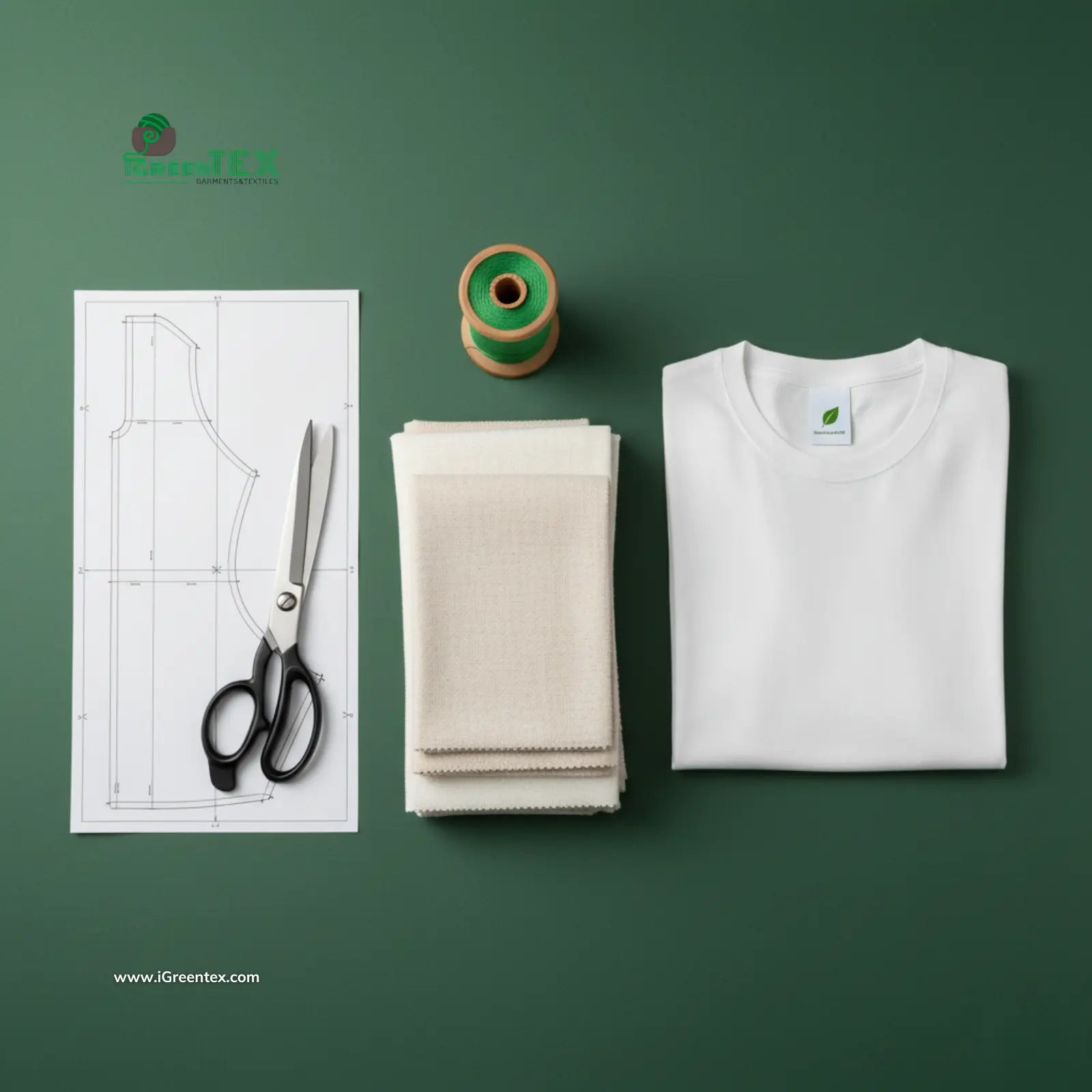
- Sourcing: Finding the right GSM and composition.
- Pattern Making: Creating digital patterns for perfect fit.
- Cutting: Using automatic cutters for precision.
- Printing/Embroidery: High-quality screen print, puff print, or detailed embroidery.
- Finishing: Ironing, folding, tagging, and bagging.
4. Technical Capabilities: What Can We Produce?
Many Small batch clothing manufacturers have limited machinery. They might only do t-shirts. iGreen Tex has a diverse production floor capable of handling various knitwear categories.
Circular Knit Specialists
Our factory excels in circular knit fabrics. This covers the most popular casual and activewear items.
- T-Shirts: Single Jersey, Heavyweight Cotton (200-300 GSM).
- Polos: Pique fabric, Mercerized cotton.
- Hoodies & Sweaters: French Terry, Fleece (Brushed/Unbrushed).
- Activewear: Poly-Spandex blends, 4-way stretch, moisture-wicking fabrics.
Advanced Decoration
A key differentiator for top-tier Small batch clothing manufacturers is decoration quality. A great shirt with a bad print is unsellable.
- Screen Printing: We use eco-friendly inks (water-based, plastisol).
- Embroidery: High-density 3D embroidery for logos.
- Heat Transfer: Durable transfers for neck labels and sport logos.
We ensure that even with a 500-piece order, your branding looks world-class.
5. The “From Concept to Port” Workflow
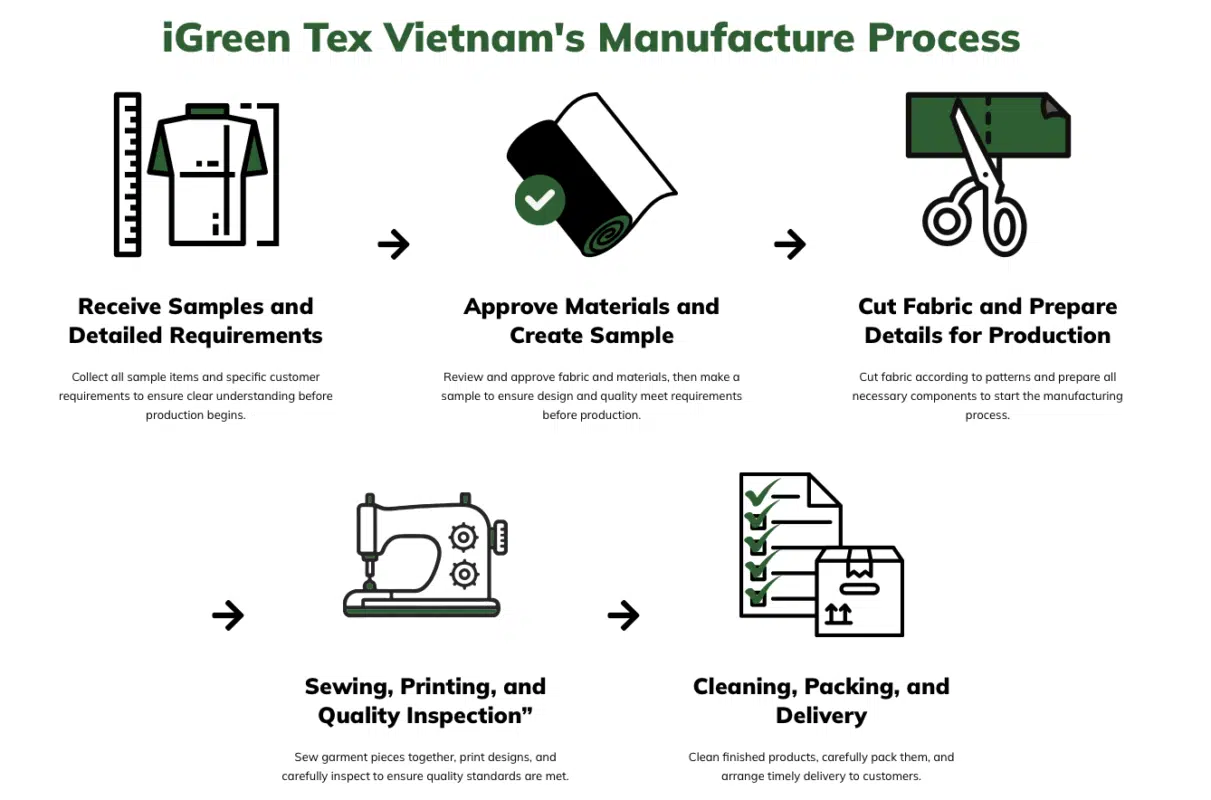
Working with overseas Small batch clothing manufacturers can seem daunting. We simplify it into a transparent 5-step process.
Step 1: The Tech Pack & Quotation
Everything starts with your Tech Pack. This is the blueprint of your product. It must include sketches, size charts, and fabric requests. Based on this, we calculate fabric consumption and labor. We provide a clear FOB estimate.
Step 2: Sourcing & Sampling (The Most Critical Step)
Before bulk production, we make a sample. This allows you to check the fit and feel.
- Note: Sample fees apply, but they are often refundable against bulk orders.
- This step separates professional Small batch clothing manufacturers from cheap workshops. We do not guess; we verify.
Step 3: PO & Deposit
Once you approve the sample, you issue a Purchase Order (PO). For Small batch manufacturing, we typically require a deposit (usually 30-50%) to purchase raw materials.
Step 4: Production & Quality Control (QC)
Production begins.
- Cutting: Fabric is relaxed and cut.
- Sewing: Inline QC checks every step.
- Final QC: We inspect finished garments for measurements, loose threads, and stains.
Step 5: Packaging & Logistics
Goods are packed according to your requirements (polybags, hangtags). We deliver to the forwarder at the port.
6. Why 500-1000 Pieces is the “Sweet Spot”
Let us return to the MOQ strategy. Why do we insist on 500 to 1,000 pieces for export clients? It is about Topic Efficiency and logistics.
Shipping 100 shirts from Vietnam to the USA is expensive per unit. Shipping 1,000 shirts significantly lowers the freight cost per shirt.
Furthermore, dyeing fabric requires a minimum volume. To get a custom Pantone color, dye houses usually ask for 300kg of fabric. For Small batch clothing manufacturers, 500-1,000 pieces allow us to knit and dye your specific fabric. Below this, you are forced to use “stock market” fabric, which limits your design uniqueness.
By committing to 500+ pieces, you gain:
- Custom Colors: Exact Pantone matching.
- Better Pricing: Lower labor and overhead allocation.
- Priority Scheduling: Factories prioritize efficient lines.
7. Navigating Challenges with Offshore Manufacturing
Honesty is part of our policy at iGreen Tex. Working with Small batch clothing manufacturers in Vietnam does have challenges, but they are manageable.
Lead Times
Good things take time. Unlike a local print shop that finishes in 3 days, overseas production takes weeks.
- Sampling: 10-14 days.
- Production: 30-45 days (depending on material availability).
- Shipping: 25-35 days (by sea) or 5-7 days (by air).
Advice: Plan your collection 3 to 4 months in advance.
Communication
Language barriers can be an issue with some factories. However, iGreen Tex specializes in exports. Our team speaks English. We use email and video calls to ensure details are understood. We are Small batch clothing manufacturers who think globally.
Conclusion: Ready to Scale with iGreen Tex?
The fashion industry is competitive. To win, you need a high-quality product and a healthy profit margin. Relying on expensive local production or fighting with massive factories is not the answer.
iGreen Tex Vietnam offers the perfect solution for the modern brand. We are dedicated Small batch clothing manufacturers who understand the balance between quality and volume.
- For Domestic Brands: Start with 300-500 pieces to dominate the local market.
- For Global Brands: Leverage our 500-1,000 piece export tier to maximize profitability.
Don’t let production headaches slow you down. Move your manufacturing to a partner that values your growth.
Are you ready to discuss your next collection?
Contact iGreen Tex today. Send us your Tech Pack, and let’s turn your design into reality.
(Next Step: Wondering about materials? Read our next guide on Sustainable Fabrics to see what we can source for you).