How EU Brands Reduce Clothing Import Costs by 12% Using EVFTA in Vietnam (And Why Most Fail to Qualify)
The European Union-Vietnam Free Trade Agreement (EVFTA) represents the most ambitious trade deal the EU has ever concluded with a developing nation. For apparel brands, the central attraction is the EVFTA textile tariff elimination schedule. iGreen Tex Vietnam provides a roadmap to 0% import duties through this agreement, offering a significant competitive edge over manufacturing hubs like China or Bangladesh.
However, achieving these savings is not automatic. It requires a rigorous understanding of trade law, specific sourcing protocols, and a partner capable of navigating complex compliance requirements. As a strategic clothing manufacturer, we help brands avoid the misconception that simply “Made in Vietnam” is enough to trigger duty-free entry. To truly benefit from the EVFTA textile tariff reductions, brands must master the Rules of Origin and ensure their entire supply chain is documented with precision.
The Real Cost of Importing Clothing into the EU
Before analyzing the benefits of the agreement, it is essential to understand the baseline financial burden. Standard EU import duty clothing Vietnam rates under the Most Favored Nation (MFN) status typically range from 8% to 12%. When these duties are applied to large-scale production, they represent a massive drain on profit margins.
Understanding the Landed Cost Breakdown
The landed cost of a garment includes the manufacturing price, shipping, insurance, and, most importantly, customs duties. When the EU import duty clothing Vietnam is eliminated, the landed cost reduction can be as high as 12%. This margin often determines whether a product line is commercially viable in the highly competitive European retail market.
| Sourcing Scenario | Fabric Origin | EVFTA Status | Duty Rate | Business Impact |
|---|---|---|---|---|
| Standard Sourcing | China / Others | Non-compliant | 10% – 12% | High landed cost; lower margins |
| Direct EVFTA | Vietnam | Compliant | 0% | Maximum savings; competitive price |
| Strategic Cumulation | South Korea | Compliant | 0% | Premium quality with duty benefits |
| High-Risk Sourcing | Mixed / Unknown | Verifying | 0% – 12% | Financial risk; potential audit fines |
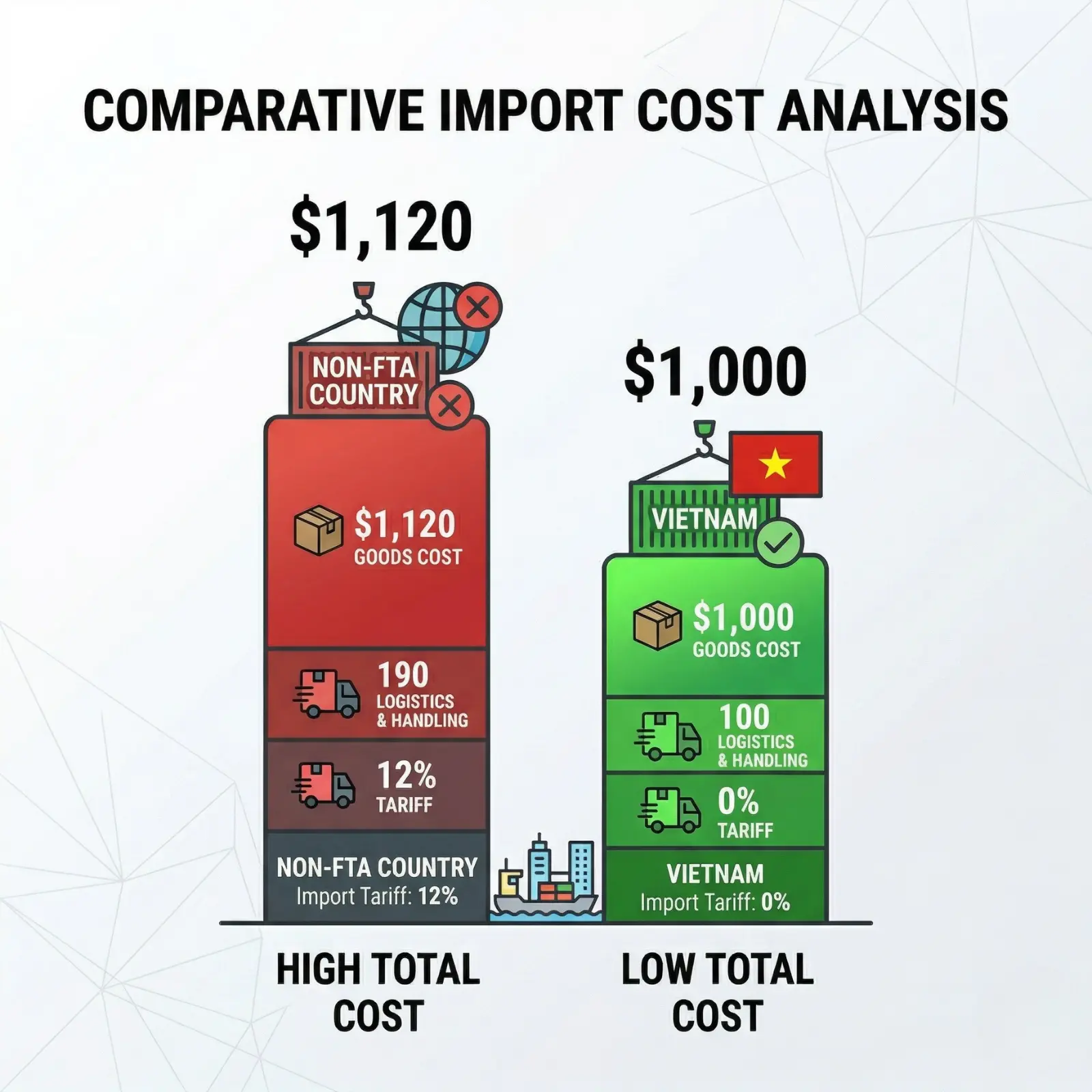
Beyond the visible duties, there are hidden costs associated with non-compliance. If a shipment is flagged during the origin verification process, it can lead to delays, fines, and the retroactive application of full MFN tariffs. Therefore, the goal is not just to find a low-cost clothing manufacturer, but to find one that understands the technicalities of international trade law.
The Impact of Tariffs on Retail Pricing
For a brand selling a jacket at €100, a 12% duty at the import stage adds significantly to the wholesale price. By leveraging the EVFTA textile tariff correctly, brands can either lower retail prices to gain market share or reinvest that 12% into higher-quality materials or marketing.
What is EVFTA and How It Reduces Tariffs
The EVFTA is a “new generation” agreement. It goes beyond simple trade in goods to include high standards for labor rights, environmental protection, and intellectual property. For the textile industry, it provides a clear tariff elimination schedule that has been in effect since August 2020.
The Preferential Tariff Mechanism
The core of the agreement is the preferential tariff. Most apparel items entered a phase-out period where duties drop to zero over three to seven years. Today, many categories already enjoy 0% or near-zero rates. However, this preferential tariff is only granted if the importer can prove the goods are “originating” in Vietnam according to specific legal definitions.
Why Vietnam is the Strategic Choice
Vietnam is no longer just an alternative to China; it is a primary destination for high-value apparel. The country has invested heavily in infrastructure and trade diplomacy. When comparing Vietnam vs China Manufacturing Cost 2026, the trade agreements like EVFTA become the deciding factor that offsets China’s scale. The EVFTA textile tariff makes Vietnam the most cost-effective premium manufacturing hub for the European market.
Why Most Brands FAIL to Get 0% Tariff
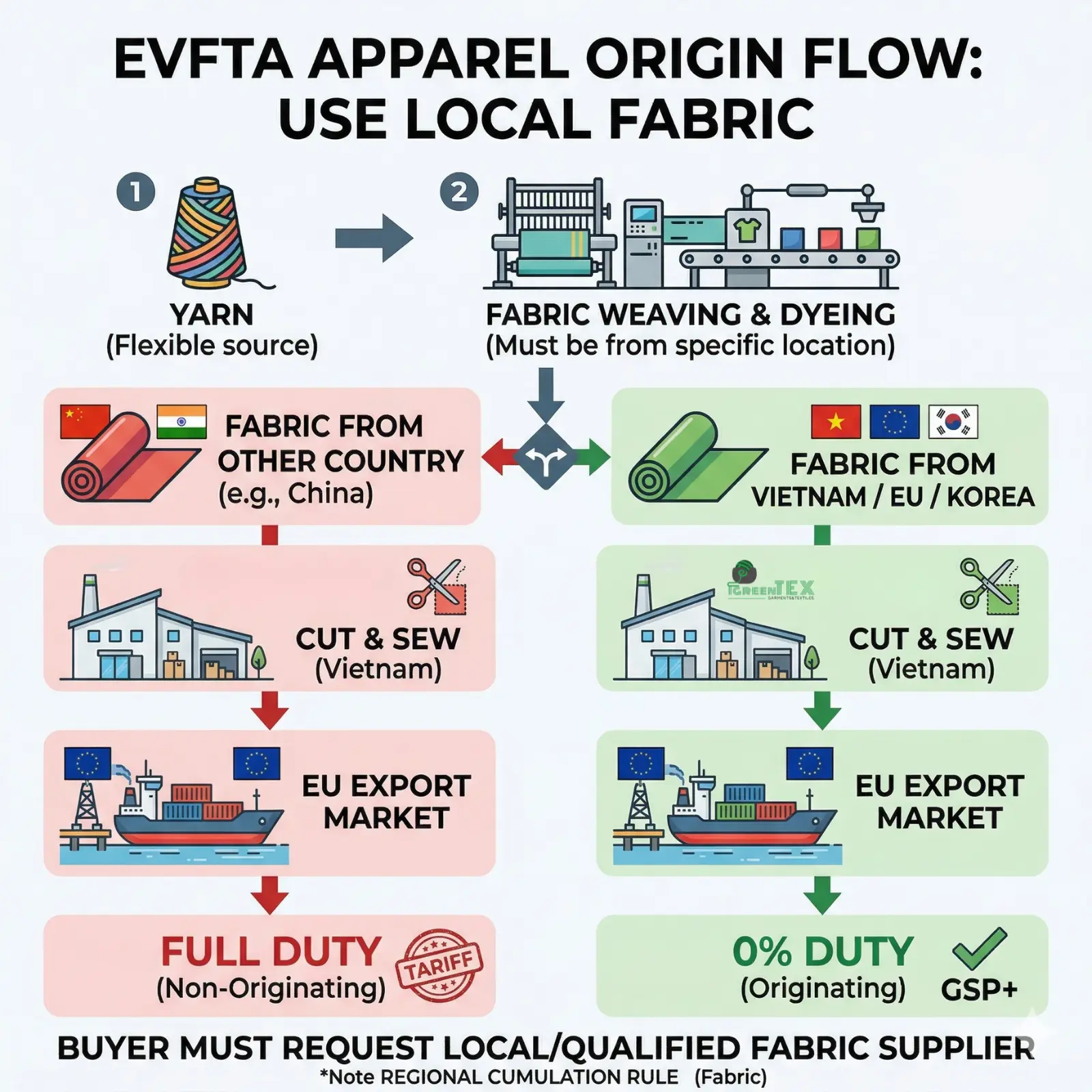
The most common reason for failure is a lack of rules of origin compliance. The EVFTA uses a “double transformation” requirement, commonly known in the industry as the fabric-forward rule.
The Fabric-Forward Rule Explained
Unlike other agreements that might only require “Cut and Sew” operations in the country of export, the EVFTA rules of origin textile protocols require that the fabric used to make the clothing must also be produced in Vietnam (or the EU). If a brand sources high-quality fabric from China, cuts and sews it in Vietnam, and then ships it to Paris, that garment is NOT eligible for the 0% EVFTA textile tariff. It will be taxed at the full 12% rate.
Common Sourcing Pitfalls
Many brands fall into the trap of using non-originating materials because they are cheaper or more readily available. However, this negates the customs duty savings provided by the FTA. To succeed, a sourcing strategy Vietnam must prioritize the use of locally produced fabrics or fabrics from countries with “cumulation” agreements, such as South Korea (for fabric only).
The EVFTA rules of origin textile requirements are strict. Without a manufacturer that can verify the origin of every yarn and meter of fabric, the risk of a “failed” import is high. This is why many brands fail; they treat the factory as a simple assembler rather than a compliance partner.
How to Qualify for EVFTA Tariff Reduction
Qualifying for the EVFTA textile tariff requires a meticulous administrative process. It is not enough to follow the rules; you must prove you followed them with a rigorous paper trail.
The Role of the Certificate of Origin (EUR.1)
The most critical document in this process is the certificate of origin (EUR.1). This document is issued by the Vietnamese authorities and serves as the legal “passport” for your goods. It certifies that the products meet the specific requirements of the EVFTA. Without a valid certificate of origin (EUR.1), European customs will automatically apply the higher MFN duty rates.
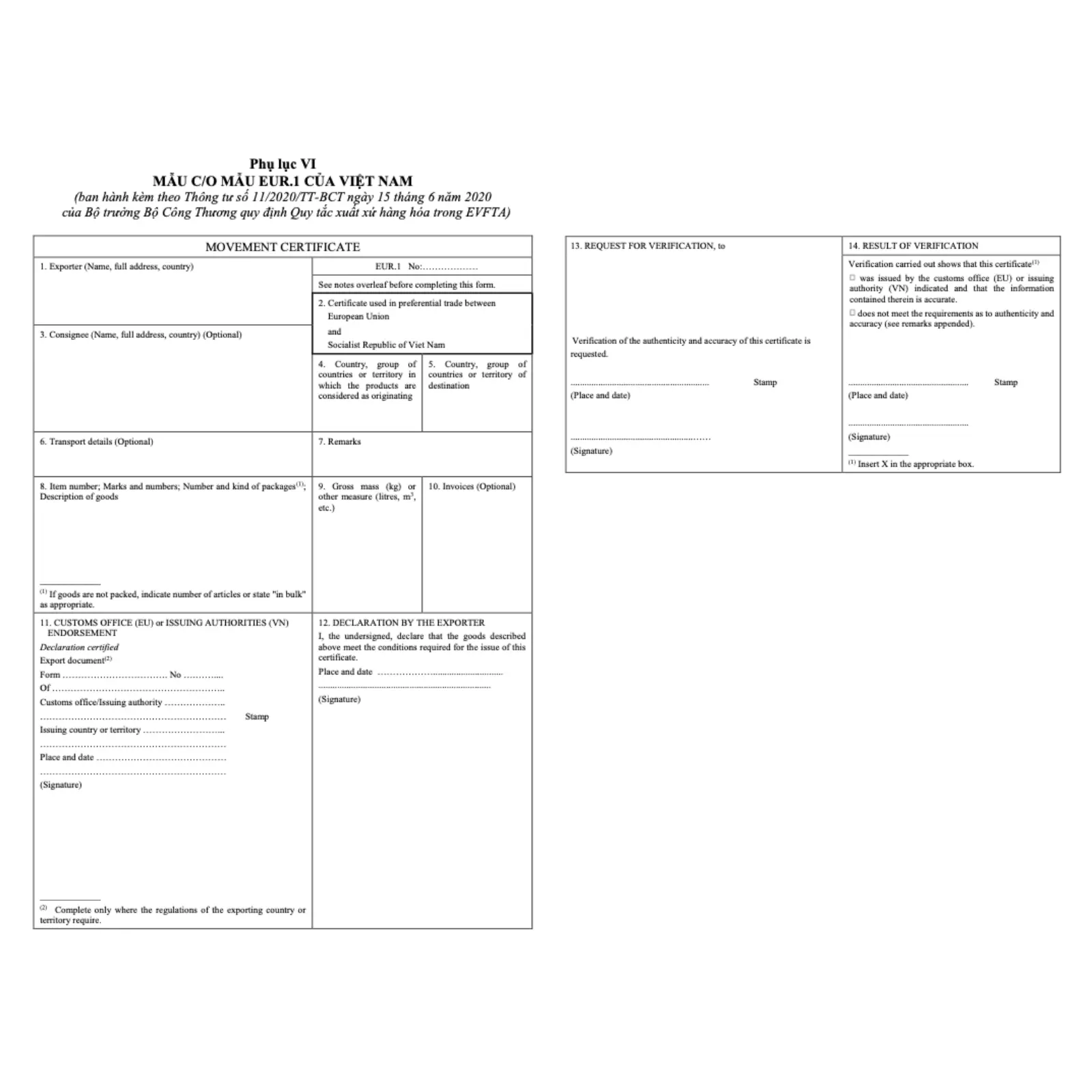
See detail: https://vcci-hcm.org.vn/wp-content/uploads/2020/06/6-2020-06-15-PL-VI-Mẫu-CO-EUR.1-clean-version.pdf
The Origin Verification Process
European customs authorities have the right to conduct an origin verification process up to three years after the goods have been imported. They can request detailed production records, fabric invoices, and even proof of power consumption from the factory to ensure the goods were actually produced as claimed. If the Vietnam clothing manufacturer for eu market cannot provide this data, the importer (the brand) is liable for all unpaid duties.
To avoid this, brands must learn how to qualify for evfta tariff reduction by selecting partners who maintain ISO-standard documentation. This is where the distinction between a “cheap factory” and a “strategic partner” becomes clear.
Strategic Sourcing: Why Vietnam Wins
Vietnam’s textile industry has matured rapidly. The government has encouraged the development of “upstream” industries, meaning more spinning mills and weaving factories are opening to support the fabric-forward rule.
Not only EU buyers are sourcing apparel in Vietnam – Australian brands are also increasingly entering the market and building long-term partnerships. To truly connect with clothing manufacturers in Vietnam for Australian brands, suppliers must understand Australian quality standards, communication expectations, and compliance requirements to build trust and sustainable cooperation.
Supply Chain Optimization for the EU
By moving production to Vietnam, brands achieve more than just customs duty savings. They benefit from supply chain optimization. Vietnam’s geographic location and its network of deep-sea ports allow for efficient shipping to Europe. Furthermore, a well-planned sourcing strategy Vietnam integrates the FTA benefits into the product development phase, ensuring that designers choose fabrics that qualify for duty-free status from the start.
Comparison with Regional Competitors
While Bangladesh offers duty-free access under the EBA (Everything But Arms) program, it is primarily focused on low-end, high-volume commodities. Vietnam, however, excels in complex garments like technical sportswear, high-end hoodies, and structured polo shirts. When you factor in the EVFTA textile tariff, Vietnam becomes more competitive than any other Southeast Asian nation for mid-to-high-end apparel.
How to Choose a Vietnam Manufacturer That is EVFTA-Ready
Selecting a Vietnam clothing manufacturer for eu market requires a checklist that goes beyond price per piece. You are looking for a partner that manages your financial risk.
Evaluating Fabric Sourcing Capabilities
A manufacturer must have a robust network of local fabric mills that meet EU quality and sustainability standards. iGreen Tex has established a strategic ecosystem of domestic suppliers for fabric and accessories, ensuring full compliance with regional value content. For brands requiring specialized materials, we also facilitate sourcing from South Korea, leveraging the cumulation provision to maintain duty-free eligibility under the EVFTA textile tariff rules.
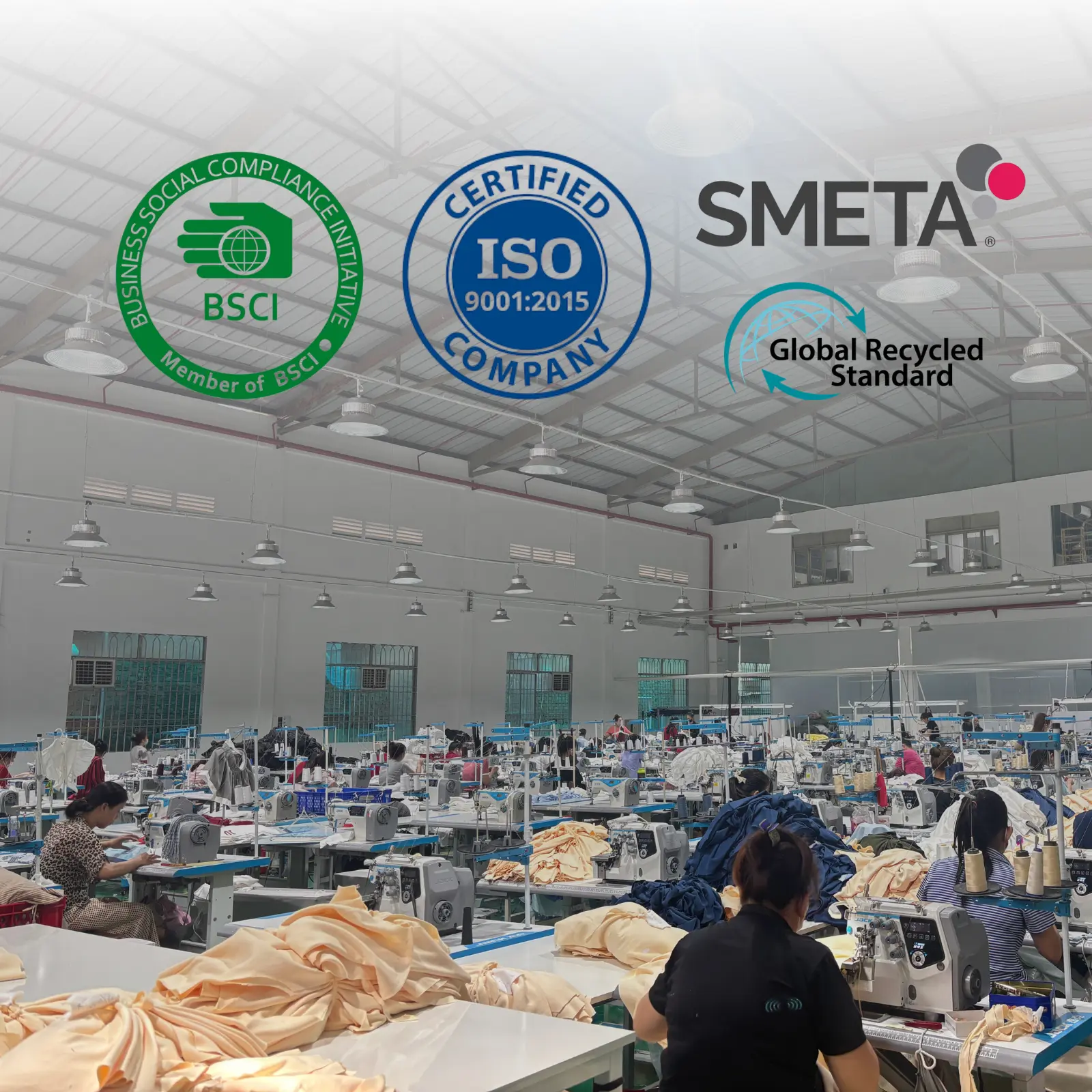
If a factory only offers fabrics from non-FTA countries, they are not an “EVFTA-ready” partner. To understand how to qualify for EVFTA tariff reduction, you need absolute transparency in the raw material stage. We provide this through our audited internal facilities—certified with BSCI, ISO 9001:2015, and SMETA—and our Vietnamese fabric partners who can provide various eco-friendly certifications (GRS, OEKO-TEX) upon request.
Documentation and Transparency
Professionalism in documentation is the hallmark of a top-tier factory. At iGreen Tex, we maintain a rigorous audit trail for every order. We understand that our clients’ profitability depends on the validity of the EUR.1 certificate. A brand should ask: “Can you provide a sample traceability report from a previous EU shipment?” Our team is equipped to handle the full issuance of the certificate of origin (EUR.1) and other necessary export permits.
Technical Expertise in Production
Quality control is the other side of the compliance coin. An FTA benefit is worthless if the goods are rejected for quality issues. Before signing a contract, you should know how to verify a garment factory in Vietnam to ensure their internal QC systems match your brand’s standards.
Final Checklist Before You Start Production
To ensure you successfully navigate the EVFTA textile tariff landscape, follow this checklist:
- Verify Fabric Origin: Confirm the fabric is woven or knitted in Vietnam or an approved cumulation country like South Korea.
- Confirm the Tariff Code: Ensure the HTS code for your garment is included in the tariff elimination schedule.
- Audit the Factory: Ensure the manufacturer has experience with EUR.1 applications and rules of origin compliance.
- Calculate the True Landed Cost: Compare the cost of local fabric + 0% duty vs. imported fabric + 12% duty.
- Set Up Record Keeping: Ensure both the brand and the factory keep all production records for at least three years.
By following these steps, brands can turn the EVFTA textile tariff from a complex legal document into a powerful tool for financial growth.
Partner with an EVFTA-Ready Strategic Manufacturer
Navigating the complexities of international trade requires more than just a supplier; it requires a strategic partner who understands the high stakes of the European market. iGreen Tex Vietnam is a premier Vietnam clothing manufacturer specializing in high-quality OEM/FOB production for global brands.
We don’t just “sew clothes.” We provide a comprehensive manufacturing solution that includes technical fabric sourcing from our domestic network, multi-stage quality control, and full support for EVFTA documentation including C/O issuance. Our internal factories are compliant with BSCI, SMETA, and ISO 9001:2015, ensuring your brand’s reputation and your customs duty savings are secured through impeccable compliance and transparent reporting.
Whether you are producing high-performance sportswear, premium hoodies, or corporate polo shirts, iGreen Tex ensures your production is efficient, compliant, and export-ready.
Ready to secure your 12% tariff savings? Contact our garment factory in Vietnam today to discuss your EU production strategy and secure your competitive advantage in the EU market.