How to Find the Best Clothing Manufacturers (A Practical Guide for Brands in 2026)
In 2026, finding a factory is very easy. A quick Google search or a scroll through LinkedIn gives you thousands of options in seconds. But having more information does not mean you will make better choices.

Finding a supplier is simple. However, finding the right partner is where most apparel brand owners fail. The reality of sourcing clothing manufacturers is that information online is often misleading. What looks like a massive, professional facility online might just be a small trading office in reality.
Clothing is not a luxury—it is a fundamental human need. As long as people need to wear clothes, the demand for apparel production will always exist. This constant demand naturally creates a highly competitive manufacturing landscape, with thousands of factories competing for the same global buyers. As a result, the market is crowded, and not every supplier you find is built to deliver consistent quality or long-term reliability.
If you are a sourcing manager, a procurement lead, or a brand founder, this article will change how you approach production. We are not just listing websites. We are giving you a framework.
This is exactly how to find the best clothing manufacturers by changing how you think, evaluate, and manage risk in your supply chain.
What Does “The Best Clothing Manufacturer” Really Mean?

What makes a good clothing manufacturer? The honest answer depends entirely on your specific business model. A factory that is perfect for a global fast-fashion retail chain will likely be terrible for a premium streetwear brand.
Low prices do not mean a good fit. Low MOQ (Minimum Order Quantity) does not guarantee long-term efficiency or consistent quality.
If you are figuring out how to choose the best clothing manufacturer, you must change your mindset immediately. You are not just looking for a facility with sewing machines. You are actively selecting apparel suppliers for your brand that align with your financial capacity and growth speed.
A factory might have the best technology in the world. But if their communication style does not match your procurement team, they are not the best for you. Knowing how to select a clothing manufacturer for your brand means understanding that “best” is a subjective term. It is about total alignment, not just technical capability.
Before You Search, Define What You Actually Need
If you start searching the internet without a clear, documented goal, you will feel overwhelmed quickly. You might choose a factory based on emotion, a slick website, or just look for the lowest unit price. This is a common and expensive mistake.
How do I find the best clothing manufacturer for my brand? You start by looking inward. Before contacting anyone, you need to define your exact requirements.
What is your specific product category? What is your target retail price segment? What are your non-negotiable quality standards? Are you a high-end label needing strict in-line quality control, or are you focused purely on high-volume basics?
To make this process objective, use the following preparation checklist before contacting any supplier:
| Preparation Category | What You Must Define | Why It Matters For Sourcing |
|---|---|---|
| Product Specifications | Exact fabric blends, tech packs, size grading, and construction details. | Factories specialize. A heavy denim factory is rarely equipped to produce lightweight activewear. |
| Volume & Scale (MOQ) | Your starting Minimum Order Quantity (MOQ) and your 12-month projection. | Finding a factory that can handle your current MOQ and your future scale prevents supply chain disruptions later. |
| Cost & Margins | Your target FOB (Free On Board) price and your final retail price segment. | Prevents wasting time negotiating with high-end premium factories when you actually need budget-friendly, high-volume production. |
| Quality & Compliance | Acceptable defect rates (AQL), required certifications (GRS, BSCI), and inspection steps. | Sets the legal and quality baseline. If you need sustainable materials, you must only audit certified facilities. |
| Timelines | Required lead time for initial sampling, bulk production, and final shipping. | Ensures the factory’s production schedule actually aligns with your seasonal retail launch dates. |
For new founders researching how to find the best clothing manufacturer for startups, the answer is always extreme clarity. You must know your target margins, acceptable defect rates, and brand direction before sending a single email.
The Reality of Material Sourcing
Before contacting a factory, you must understand a critical truth about clothing production. Most garment factories do not weave their own fabrics; they buy them. Therefore, you must clarify your fabric sourcing strategy immediately. Will you provide the fabric, or will the factory source it?
If you need specialized materials, like organic cotton or recycled polyester, ask the factory directly. Can they source these materials locally within Vietnam, or must they import them? Knowing this upfront prevents major delays later. It ensures your production schedule remains realistic and achievable.
The Golden Rule: No Tech Pack, No Quote
Never ask a professional factory for a price without a detailed Tech Pack. A reliable manufacturer will audit your Tech Pack carefully before providing a quote. They use this document to calculate exact fabric consumption and identify potential manufacturing risks. This process minimizes fabric waste and ensures accurate pricing.
If your target price is tight, a good factory will suggest alternative fabric blends. They find solutions that maintain quality but lower your costs. This professional evaluation separates a true manufacturing partner from a simple order-taker. Be wary of any factory that quotes instantly without reviewing technical details.
If you do not define your standard, the factory will define it for you. This preparation is the foundation of how to find the best clothing manufacturers.
From Global Options to the Right Fit
The global garment industry is highly concentrated. Before you start contacting suppliers, you must understand the macro landscape. According to data from the WTO, UN Comtrade, and regional industry associations, five countries dominate global apparel manufacturing:
- China: The undisputed leader. China holds roughly a 30% global market share, with apparel exports reaching approximately $165 billion in 2024. They offer a complete supply chain, over 10 million workers, and advanced production technology (Shenglu Fashion).
- Bangladesh: Ranked second globally with a 7.9% market share in 2022. Exporting around $2.79 billion in H1 2025, Bangladesh is known for low costs and high-volume cotton production for major retail brands (TradeInt).
- Vietnam: The third-largest exporter globally, exporting approximately $34 billion in apparel in 2024. Vietnam is a strategic choice for the “China Plus One” diversification strategy. The country benefits significantly from Free Trade Agreements (FTAs) such as CPTPP and EVFTA. These agreements significantly reduce import duties for major markets such as Europe, Australia, and Canada, thereby improving your profit margins. Furthermore, Vietnam has heavily modernized its logistics infrastructure to support rapid global exports. Major deep-water ports, such as Hai Phong in the North and Cai Mep in the South, handle massive cargo volumes. This modern infrastructure allows for direct shipping routes to major international markets without slow transit stops. This efficiency significantly reduces total transit times and lowers hidden shipping costs for your business.
- India: Ranked fourth, with exports reaching $4.07 billion in H1 2025. India offers a deeply diverse textile ecosystem, a massive workforce, and is actively absorbing production shifting away from China (TradeInt).
- Turkey: A premium manufacturing hub. Turkey maintains a stable global market share by focusing on high-end expertise and leveraging its close geographical proximity to the European Union market (Shenglu Fashion).
However, macro data does not equal micro success. You might read a choosing a clothing manufacturer guide that insists you must produce in a specific region based on these volumes. But the real goal is finding a facility that fits your specific operational needs.
Whether you look in South Asia, Europe, or elsewhere, you are ultimately looking for a reliable clothing factory. For example, many experienced sourcing managers look toward Vietnam for its balance of highly skilled labor and politically stable production environments.
The secret is prioritizing capability and transparency over raw geography. Do not just pick a country because of its export volume; pick a system that works for your brand.
Where Do People Actually Find Clothing Manufacturers Today?
The internet has completely changed how procurement teams operate. How do beginners find clothing manufacturers today? They usually start with search engines, B2B sourcing platforms, and social media networks.

While access to factory names is easy, the risk factor is incredibly high. Real, reliable information is mixed tightly with fake profiles and trading companies pretending to be direct factories. Online reviews on B2B platforms are not always completely trustworthy.
Knowing how to find the right clothing manufacturer means knowing how to aggressively filter this massive amount of data.
The basic steps to find a clothing manufacturer involve checking Google, verifying company histories on platforms like LinkedIn, and looking for independent, third-party reviews. But you must always remember a critical rule: a beautiful, expensive website does not always equal a clean and efficient factory floor.
How to Use Free Tools to Find Reliable Manufacturers
You do not always need to buy expensive industry databases to find good partners. Procurement teams can learn how to find reliable garment manufacturers using free tools very effectively.
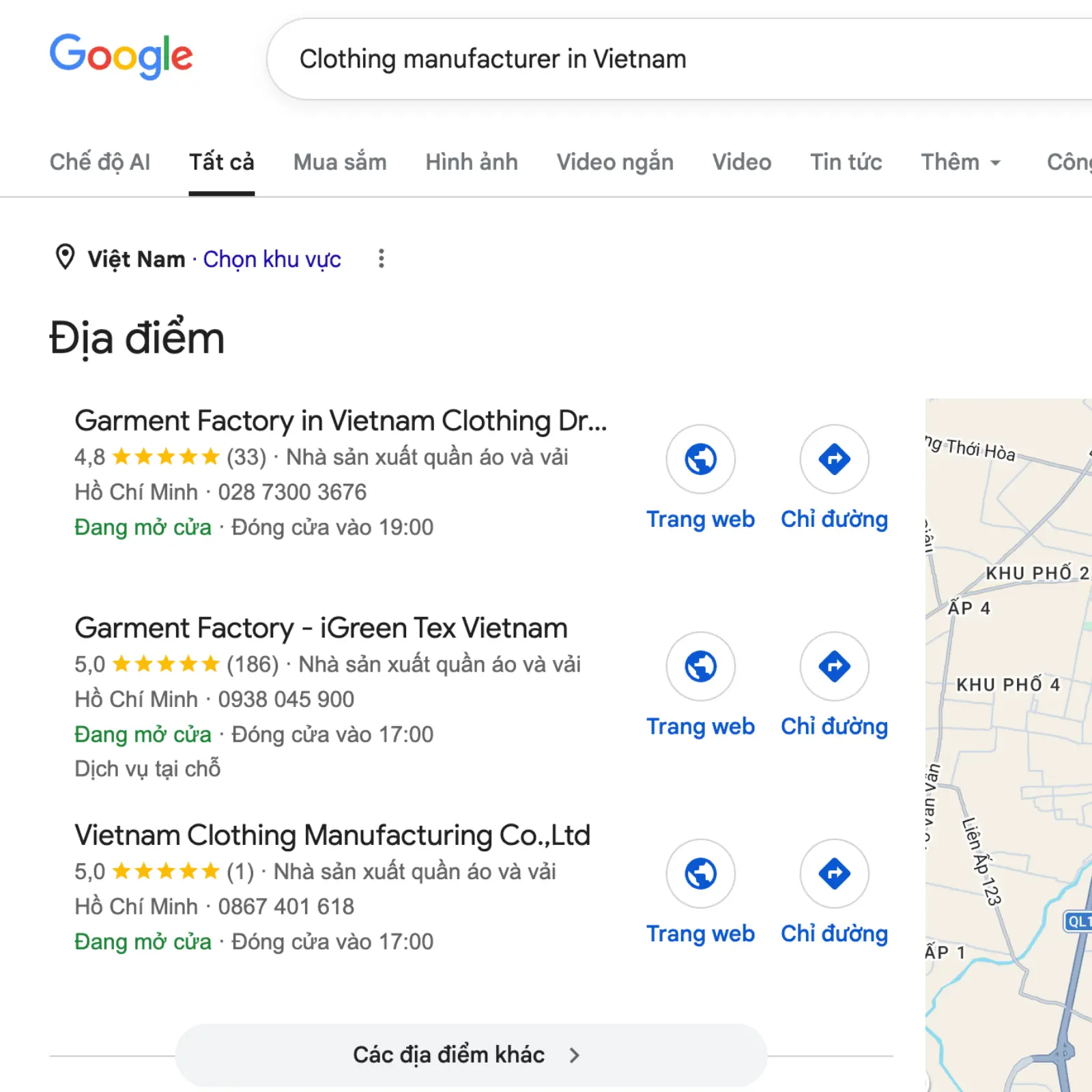
Start with Google search. Use specific, combined keywords like your exact product type plus a location. This targeted searching is one of the most effective steps to find a clothing manufacturer. Such as, “clothing manufacturer in Vietnam“, “Vietnam clothing manufacturer“, “clothing factory in Vietnam“,…
Check social platforms with a critical eye. Real manufacturing businesses have a consistent, multi-platform presence. Look at LinkedIn to see their professional network and management team.
Look at Facebook or Instagram for unedited, daily factory floor updates. If you want to know how to choose the best clothing manufacturer, look at how they present their actual working environment online. Are they showing real workers, or just 3D mockups?
Furthermore, if you are explicitly looking into how to find sustainable clothing manufacturers, check their websites for verifiable certification numbers like GRS, BSCI, or ISO, and cross-reference them with the issuing bodies.
If you want to narrow down your search to Vietnam’s main industrial hub, evaluating suppliers in the southern economic region gives you better logistics access.
Read more: Top 5 Ho Chi Minh City Clothing Manufacturers
Sourcing Through Third Parties: Is It Worth It?
Sometimes, finding a factory directly takes too much time and resources. This is exactly where sourcing agents and buying offices come in. They act as local middlemen to help you find, audit, and manage factories.
Using an agent is a very common strategy when sourcing clothing manufacturers. If your apparel brand lacks local language skills, on-the-ground presence, or simply lacks the time, a good agent can be highly valuable.
However, you must still know how to find the right clothing manufacturer even when you are using an agent. You have to evaluate the agent’s transparency just as strictly as a factory. Do they let you communicate directly with the factory management? Do they hide the factory name?
Learning how to select a clothing manufacturer for your brand sometimes means finding the right, transparent middleman first.
Don’t Ignore Your Network (The B2B Reality)
In the serious B2B world, referrals remain the most powerful and reliable channel. Ask your professional network. Speak to other apparel brand owners, logistics partners, and industry communities.
The data strongly supports this strategy. Research shows that 91% of B2B purchasing decisions are influenced by word-of-mouth. The financial risks in bulk apparel manufacturing are massive, making trust essential. Furthermore, 84% of B2B buying decisions start from a direct referral.

Trust is always stronger than marketing budgets. A direct recommendation from a trusted sourcing manager who has run actual production is worth more than ten pages of Google search results.
When you ask your network how to select a clothing manufacturer for your brand, you get honest, unfiltered feedback. You hear the hard truth about delivery delays, hidden quality issues, and aggressive communication styles.
This real-world, peer-to-peer insight is a critical part of how to find the best clothing manufacturers. It bypasses the marketing completely.
You Found a Manufacturer — But Can You Trust Them?
Finding a factory online or through a referral is not the end of the process. What you see on a website or hear in a pitch is not always the truth. You must verify their claims rigorously to protect your business. Do not skip these validation steps just to save a few weeks of time.
Deep Verification: Moving Beyond Certificates
Many factories display compliance logos like BSCI or WRAP on their websites. However, simply seeing a logo online is insufficient proof of ethical practices. Professional buyers always request the full, unedited audit reports from independent third-party inspection firms.
More importantly, ask to see their Corrective Action Plan (CAP). A reliable manufacturer is completely transparent about past audit findings. They will gladly show you their step-by-step plan to fix any identified problems. A factory that hides its audit reports or claims perfection is hiding significant risks.

Financial Health and Contractual Red Flags
A supplier’s approach to finance and contracts directly reflects their reliability. Unprofessional payment demands are serious red flags indicating potential financial instability. You must protect your company’s capital by recognizing these dangerous warning signs early.
- Unusual Deposits: The industry standard is typically a 30% to 50% upfront deposit to purchase raw materials. If a factory demands 70% or more upfront, they might have severe cash flow problems.
- Personal Bank Accounts: Payments should only go to a verified corporate bank account. Sudden requests to change account details or pay a personal account indicate a high risk of fraud.
- No Manufacturing Agreement: Do not rely on simple emails or basic Purchase Orders for bulk production. A strong contract must define quality standards, exact delivery deadlines, and clear financial penalties for failure.
- Unauthorized Subcontracting: Your contract must strictly prohibit the factory from outsourcing your order to smaller, unverified workshops without your explicit written consent.
Following strict steps to find a clothing manufacturer requires verification at every level. Do not skip this validation step just to save a few weeks of time. If you do not know how to choose the best clothing manufacturer through auditing, you will pay for it during production.
Whether a supplier comes from Alibaba vs trade fair, the verification process should remain the same. Buyers should always validate business licenses, production capabilities, quality systems, and previous export experience before placing any order.
The Quality Control Reality: Beyond the Buzzwords
Quality control is one of the most important characteristics of a professional clothing manufacturer. Without a robust quality control system, small errors multiply quickly across thousands of garments. Professional factories implement strict, multi-stage inspections rather than just checking items at the very end.
The Three-Stage Sampling Protocol
Developing a perfect sample requires patience and a structured, multi-step process. A factory rushing this stage often produces poor bulk results. Ensure your partner follows a disciplined sampling protocol.
- Lab Dips (3-5 Days): The factory dyes small fabric swatches to match your specific Pantone colors precisely for approval.
- Fit Sample (7-10 Days): They create a prototype using available fabric solely to test the measurements, drape, and overall silhouette.
- Pre-Production (PP) Sample: This is the ultimate “Golden Sample,” created using the actual bulk fabric and final trims.
Both you and the manufacturer must keep an identical, sealed copy of the approved Golden Sample. Your contract must legally state that bulk production will match this sealed standard exactly.
The Essential Four-Step Inspection Process
A reliable factory integrates quality checks seamlessly into their daily workflow. This proactive approach saves significant time and prevents costly material waste.
| Inspection Stage | Action Performed | Why It Matters |
|---|---|---|
| 1. Incoming Material | Every fabric roll is inspected over light tables before cutting begins. | Identifies weaving defects and shading issues early, preventing flawed garments. |
| 2. Fabric Relaxation | Knit fabrics are allowed to “rest” for at least 24 hours. | Prevents unexpected shrinkage and distortion after the fabric is cut. |
| 3. In-Line QC (DUPRO) | Floor inspectors check stitching accuracy directly on the active sewing lines. | Catches construction errors immediately, allowing for rapid correction before finishing. |
| 4. Final Inspection | Random checks are performed on finished, packaged goods using the AQL 2.5 standard. | Guarantees the entire shipment meets strict international quality baselines before export. |
The Hidden Definition of “Best” (A Real Sourcing Perspective)
Many factories have the modern machinery required to make your product. But technical capability does not equal reliability. How do I choose the right apparel manufacturer? You look for the one that provides peace of mind.
Consider a real scenario that happens often to importers. A brand receives bulk production with incorrect measurements across 30% of the units. The factory’s response is to blame the brand’s tech pack and offer a 5% discount on the next order. The brand loses the entire selling season and damages retail relationships.
That is not how problems should be handled. A bad factory hides issues and ships late. A great factory stops production, informs you immediately, and offers a proactive solution at their own cost.
A bad experience causes lost sales and ruined reputation. This is exactly why how to find the right clothing manufacturer is really about advanced risk management.
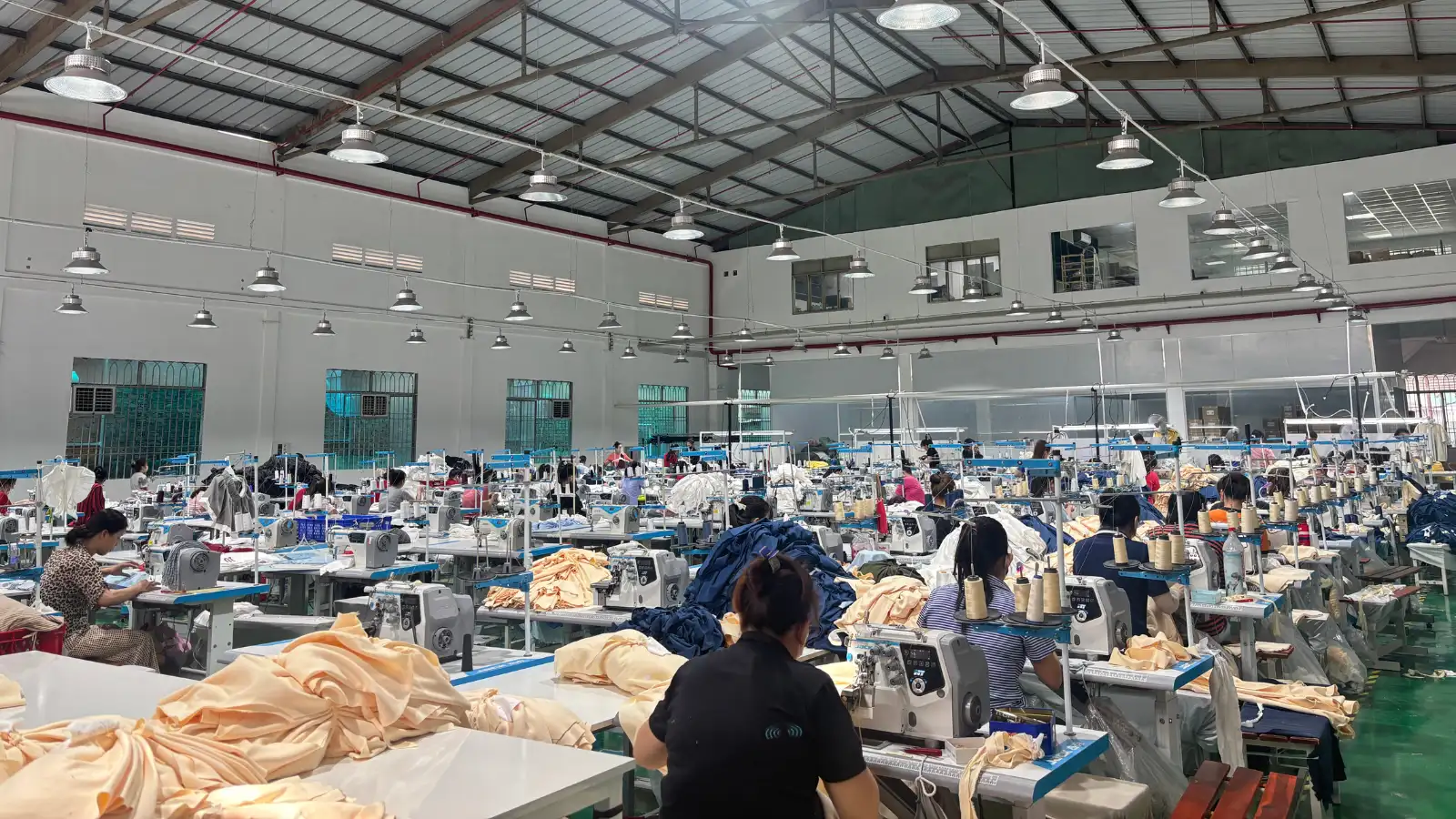
A good manufacturer produces garments. A great manufacturer protects your business and lets you sleep at night. If you are a serious brand owner looking for a reliable partner, you need an OEM clothing manufacturer service to scale your business safely.
Transparency and accountability are the core elements of how to find the best clothing manufacturers.
If You’re a Beginner, Where Should You Start?
If you are an experienced sourcing manager, you already know the risks. But if you are new, do not try to do everything at once.
Start with free search tools and gather basic market information. Prioritize Google, B2B directories, and building your network. If you are actively figuring out how to find low MOQ clothing manufacturers or how to find private label clothing manufacturers, focus heavily on clear, early communication. A factory that answers beginner questions clearly and patiently is a very good sign.
One of the most vital steps to find a clothing manufacturer is to educate yourself on the entire production workflow first. You cannot evaluate a factory if you do not understand the process.
If you need a complete, strategic foundation before reaching out to suppliers, I highly recommend reading our detailed guide on how to start a clothing line step by step. It will show you exactly why supplier choice dictates your success.
Take your time. Rushing the process is the ultimate enemy.
So, Have You Found the Right Manufacturer Yet?
There are many ways to find a supplier today, and no single method is absolutely correct for every business model.
How to find the right apparel manufacturer requires testing them against your specific, documented needs. The right factory is rarely the one with the most aggressive sales pitch or the flashiest website. It is the one that fits your business model, respects your quality expectations, and handles crises professionally.
Mastering how to choose the best clothing manufacturer takes deep patience. It requires asking the right technical questions and demanding absolute transparency from your production partners from day one.
Ultimately, knowing how to select a clothing manufacturer for your brand is about finding a long-term strategic partner, not just a transactional vendor. This is the most important lesson in how to find the best clothing manufacturers.
Ensure you never compromise on the steps to find a clothing manufacturer to protect your brand equity. Price is important, but reliability is everything.
Ready to apply these sourcing strategies? To save you time, we have reviewed and compiled a list of the most capable facilities operating in the country right now.
Read more: Top 7 Clothing Manufacturers in Vietnam
A Short Note from iGreen Tex
Many experienced sourcing managers and apparel brand owners find us through direct referrals or after facing severe supply chain failures elsewhere. They come to us because they are exhausted by inconsistent quality, delayed shipments, and poor communication.
At iGreen Tex, our core value is not just manufacturing; it is peace of mind. We provide transparent production processes, strict multi-stage quality control, and proactive problem-solving. We understand exactly how stressful international apparel production can be for procurement teams.
If you are still analyzing how to find the best clothing manufacturers, remember this core truth: At the end of the day, what most brands really want is not just a completed production run. It is the ability to sleep well knowing their orders, their money, and their brand reputation are in safe, professional hands.
If your brand needs a highly reliable manufacturing partner with proven systems in Vietnam, we are ready to help. Our production lines efficiently handle capacities up to 160,000 pieces per month. We offer flexible Minimum Order Quantities (MOQs) starting from 500 to 1,000 pieces per style.
We stand firmly behind the quality of every single garment we produce for you. iGreen Tex provides a comprehensive 3-month warranty covering manufacturing defects, printing issues, and stitching errors. If you encounter any covered issues, we guarantee a one-to-one exchange. Contact iGreen Tex today for a technical consultation to discuss your specific production needs safely.